

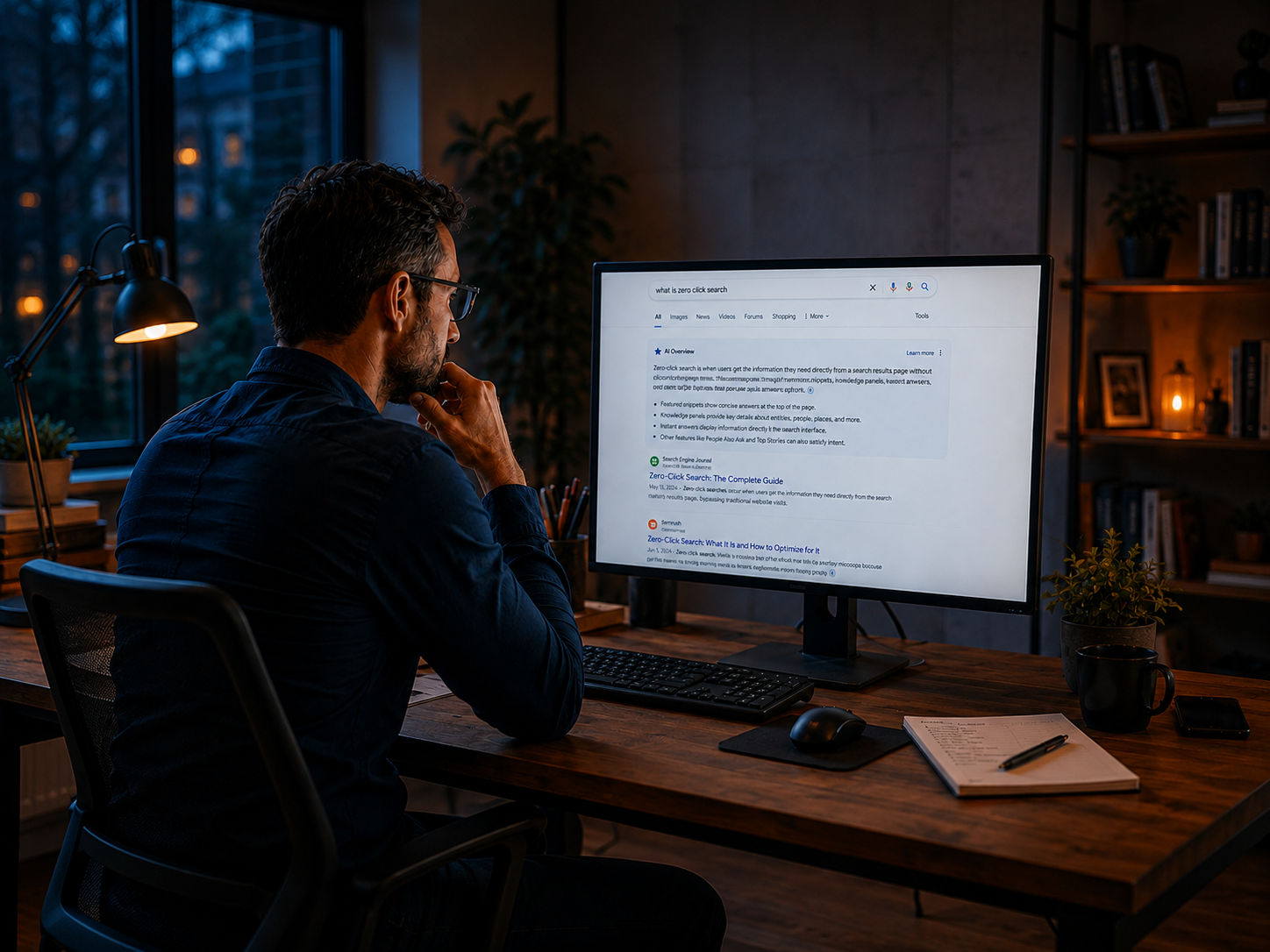
What Is a Zero-Click Search?
A zero-click search occurs when someone performs a search without clicking on a result that leads to another website. They may have found their answer directly on Google. They may also have viewed a map, consulted a business profile, placed a call, performed another search, or simply abandoned their search. The figures vary depending on the studies and the calculation method used. However, a study published by SparkToro and Datos estimated that approximately 58.5% of Google searches in the United States and 59.7% in the European Union did not generate a click to an external website. These figures should still be viewed with some perspective. A zero-click search does not always mean that Google answered the question perfectly. In many cases, the person simply continues their search in another way. The fairest way to present the situation would therefore be as follows: depending on the calculation method used, approximately one in two Google searches may now end without a click to a website. The zero-click search phenomenon is not new. However, AI-generated answers may intensify it.
Do AI-Generated Answers Reduce Clicks?
A Pew Research Center study analyzed the browsing behaviour of 900 American adults in March 2025. When an AI-generated summary appeared in Google results, users clicked on a traditional result in 8% of the visits observed. When this type of summary was not present, the rate increased to 15%. Sources cited directly in the generated answers also received very few clicks. This study does not mean that every website will lose half of its traffic. It does, however, confirm a clear trend: the more complete an answer Google provides directly in its results, the less need the user has to click. For a business leader, the real issue therefore goes beyond a simple decline in traffic.
The Real Risk: Being Absent from the Answer
Imagine that a prospective client is searching for the best solution to their problem, comparing two services, or trying to understand how much a project might cost. An AI-generated answer can give them a useful overview. It may also mention certain businesses, repeat their arguments, or use their content to explain the topic. Your prospective client may therefore begin forming an opinion before even visiting your website. The real question then becomes: If your prospective client gets their answer without visiting your website, will your business still be part of that answer? If your business is absent, a competitor may take its place. If your services are poorly explained, search engines may misunderstand what you do. If your content is too vague, it will have little chance of being used or cited. Zero-click search is therefore not only a matter of website visits. It is also a positioning issue.
Your Digital Presence Begins Before the Click
For a long time, website performance was assessed mainly by looking at the number of visits, pages viewed, and forms submitted. These metrics are still useful, but they no longer tell the whole story. Before even reaching your website, a potential client may already know what you do, where you operate, who you serve, and what sets you apart. They may also have read reviews, viewed your Google Business Profile, or compared your business with others. This first impression can now take shape on Google, in a video, in a social media post, or in an answer provided by an artificial intelligence tool. In other words, your digital presence begins before the click. And that is precisely why the content on your website is becoming even more important.
Your Website Supports Your Visibility Elsewhere
A website is no longer intended only for visitors who consult it directly. It also serves as a source of information for search engines and artificial intelligence tools. A strong service page should clearly explain what is offered, who the service is intended for, which problems it solves, how the process works, and why the business is credible. Google also confirms that the fundamentals of SEO remain relevant to its generative search features. A page must be crawlable, understandable, and indexable. Its content must also be useful, clear, and distinctive. SEO is therefore not being replaced by artificial intelligence. It simply needs to adapt to a more conversational search environment.
The Website Remains Essential
An AI-generated answer can summarize information. It does not always replace the level of trust required before an important decision. When someone needs to choose an agency, a professional, or a supplier, they generally want to go further. They want to see past work, case studies, the team, the work process, and the overall quality of the business. The website remains the place where an organization fully controls its image, its message, and its conversion journey. Its role is now twofold: to convince visitors who arrive on the website and to provide a clear information base so that search engines can represent the business accurately elsewhere.
Less Traffic Does Not Necessarily Mean Fewer Clients
A decline in organic traffic can be concerning, but it should never be analyzed on its own. Not all visits have the same value. Losing 500 visits from people looking for a general definition does not have the same impact as losing 20 visitors who were actively comparing suppliers. Some simple questions can now be answered directly on Google. Users with a more complex need may still visit the websites of businesses they have discovered and arrive with a clearer idea of what they are looking for. Google also states that clicks from certain AI-powered search experiences may be more qualified. Because this claim comes from Google, it should be considered with some caution. It nevertheless highlights an important point: traffic volume alone is not enough to measure the quality of business opportunities. A business may therefore lose part of its traffic while maintaining its quote requests, calls, or sales.
You Need to Look Beyond Traffic
Organic traffic remains important, but it must be considered alongside other indicators. These include the number of quote requests, lead quality, phone calls, appointments, searches made directly using the business name, and the performance of service pages. Local visibility also matters greatly. A business should verify whether it appears when people search for a provider in its region. It is also becoming relevant to observe how the business is presented on Google, ChatGPT, and other answer engines. Is it mentioned? Are its services clearly explained? Are competitors more visible? This measurement is still imperfect, but it is becoming increasingly important.
How Can You Help Search Engines Better Understand Your Business?
There is no formula that guarantees a business will be cited in an AI-generated answer. However, certain practices can improve the quality and clarity of its content.
- Important services should first have their own dedicated page. A single page that groups everything together rarely provides enough detail to answer users’ specific questions.
- Content should also be based on the real questions clients ask. Conversations with the sales team, phone calls, and quote requests are often the best sources of ideas.
- Businesses should then demonstrate concrete expertise. They benefit from sharing their methods, observations, examples, and results rather than publishing content that is too general.
- Information structure also matters. Clear headings, direct answers, and well-organized pages make content easier to read for both people and search engines.
- Structured data can also help Google understand certain information, although it does not guarantee better visibility in generated answers.
- Finally, important information should remain consistent from one platform to another: business name, services, contact details, service areas, and other basic information.
Do Not Write for Robots
The rise of AI is pushing some businesses to produce large amounts of content quickly. The problem is that content that is too generic or repetitive may fail to provide anything genuinely useful. The best content should be easy for a person to understand while remaining clear and well structured enough to be interpreted by a search engine. There is therefore no need to choose between writing quality and technical structure. The two should work together.
Is It Still Worth Investing in Your Website?
Yes. Businesses simply need to stop viewing the website only as a destination. The website is also a knowledge base about the business. The more search engines answer users directly, the more they need reliable and well-organized sources. Reducing content efforts because people are clicking less could therefore have the opposite effect. A business that publishes less information also gives search engines less material to understand it accurately. The right approach is not to keep publishing more. It is to explain services more clearly, demonstrate expertise, and answer the questions prospective clients are genuinely asking. Your website remains at the heart of your digital presence. It must convince the people who visit it, while also providing search engines and artificial intelligence tools with the right information to understand and represent your business accurately. In a context where part of the decision-making process now takes place before the click, it is becoming important to verify what Google and answer engines truly understand about your services, expertise, and positioning. A visibility audit can help identify the strengths of your current presence, the information that is missing, and the opportunities to be better understood, better referenced, and more frequently included in the answers consulted by your prospective clients. Acxcom can help you carry out this work and adapt your website to this new way of searching, comparing, and choosing.