

Online shopping now plays an important role in purchasing habits. In Canada alone, online retail sales reached $73.7 billion in 2024, an increase of 9% compared with the previous year. Behind this figure are millions of purchase journeys. A person discovers a business, browses a category, looks at a product, perhaps adds it to their cart, begins checkout and, in some cases, completes the purchase. But this journey does not always go as planned. Some people leave the site quickly. Others browse several products without taking action. Some fill their cart, then postpone their decision. Others begin checkout but abandon before completing the transaction. According to the Baymard Institute, approximately 70% of online shopping carts are abandoned. This does not mean that all of these sales could be recovered, but the figure shows why it is important to understand what happens between the first visit and the purchase. When an online store sells less than expected, the problem does not always come from traffic. It may also be found within the purchase journey itself.
What is a purchase journey?
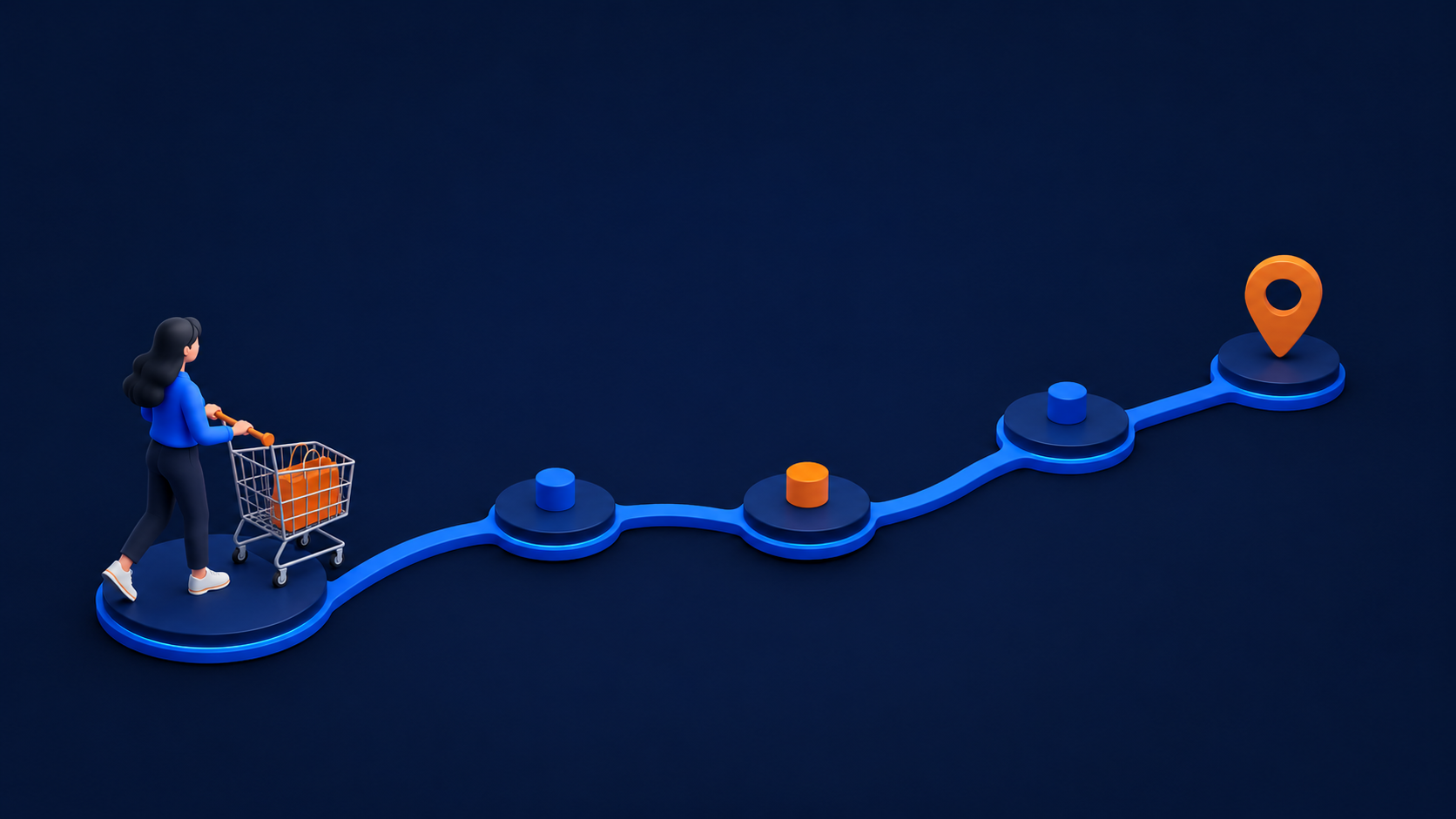
The purchase journey represents the different steps a person takes before becoming a customer. For an online store, it may look like this: Arrival on the website – product view – add to cart – checkout started – purchase. Depending on the business, this journey may also include an internal search, comparing several products, checking shipping costs, creating an account or returning to the site a few days later. The goal is not only to count sales. It is also important to understand what happens before the sale, or before the purchase is abandoned.
Traffic does not tell the whole story
When an online store generates few sales, the first instinct is often to look for more visitors. Businesses think about SEO, social media, advertising or newsletters. These efforts may be necessary. A little-known website cannot generate a high volume of sales. But an online store may also already be receiving traffic without converting enough visitors. In that case, paying to attract even more people does not necessarily solve the real problem. It is a little like
bringing more customers into a store where it is difficult to find products, understand the offer or complete a purchase. Improving the purchase journey can also produce significant results. According to Baymard’s research, an average large e-commerce site could increase its conversion rate by approximately 35% by correcting checkout-related design issues alone. This is potential observed in their research, not a guaranteed result for every online store.
Where are sales being lost?
We often talk about abandoned carts, but visitors can leave well before reaching that stage. A person may arrive on the site without exploring any products. In that case, the landing page, navigation, website speed or quality of the traffic may be the issue. They may also view a product without adding it to their cart. The clarity of the product page, photos, price, availability, features, reviews and shipping information should then be examined. When a product is added to the cart but checkout does not begin, the person may want more time to think or compare options. They may also have discovered unexpected fees or failed to find the information they needed to make a decision. Finally, someone may begin checkout without completing it. A form that is too long, mandatory account creation, a missing payment method, a technical error or a poor mobile experience may be enough to lose the sale. Additional costs are among the leading causes of abandonment. In one Baymard study, 39% of respondents mentioned unexpected costs, such as shipping or taxes, among the reasons they left. A checkout process that was too long or complicated was cited by 18%.
Viewing the journey as a funnel
A purchase journey can be represented as a funnel: 1,000 visitors – 450 product views – 120 additions to cart – 55 checkouts started – 30 purchases. This makes it possible to quickly see where the largest drop-off occurs:
- If few visitors view products, the navigation and landing pages should be examined
- If products are viewed but rarely added to the cart, the issue may lie with product pages, pricing or the offer
- If several carts are created but few people begin checkout, fees, cart clarity or hesitation before the purchase should be examined
- If checkouts are frequently started but not completed, the checkout process becomes the priority
The funnel shows where people leave, but not always why. The data can be supplemented with heatmaps, anonymized session recordings, internal search analysis, payment errors or short surveys. The numbers show where to look. Observation then helps determine what should be corrected.
Improve the journey before remarketing
The first strategy should not always be to follow visitors with emails and advertising. The priority should first be to reduce the reasons that make them leave. This may mean clarifying categories, improving search, adding information to product pages, presenting fees earlier, making buttons more visible or simplifying the cart. A few changes to the checkout process can also make a difference: reducing the number of fields, allowing guest checkout, offering the expected payment methods and ensuring that the process works smoothly on mobile devices. It may also be useful to allow a person to retrieve their cart when they return later. Sometimes, the best way to recover an abandoned cart is simply to provide a journey that gives people fewer reasons to leave.
Re-engaging people who are still interested
An abandonment does not always mean that the person has lost interest. They may have been interrupted, wanted to compare options or simply decided to postpone their decision. When an email address is known, the store can send a reminder featuring the products left in the cart and a link allowing the person to resume their purchase. Remarketing can also be done through Google, YouTube, Facebook or Instagram. Some platforms also make it possible to use text messages, notifications, back-in-stock reminders or price-drop alerts. The follow-up should, however, reflect the level of interest demonstrated. Someone who only viewed a product page should not receive the same message as someone who almost completed checkout.
A short sequence rather than a single message
A first email can simply remind the person that their cart is still available. A second can address possible concerns about shipping, warranties, returns or availability. A third can offer assistance or, when appropriate, a special offer. A discount should not be automatic. If an online store always sends a promotional code after an abandonment, it may teach customers that it is better to wait before making a purchase. The sequence should also stop as soon as the transaction is completed.
Tools vary by platform
The available options are not the same for every online store. Shopify directly provides statistics on abandoned orders and checkouts, as well as various marketing automation features. Wix Stores also includes cart reports and automated follow-up features. WooCommerce offers a great deal of flexibility, but often requires functions to be added separately. A plugin or configuration in Google Tag Manager can be used to measure the purchase journey. Another plugin can record abandoned carts and automate certain follow-ups. Other platforms, such as BigCommerce and Adobe Commerce, as well as specialized email marketing solutions, may also distinguish between product views, additions to cart, checkouts started or back-in-stock requests. The goal is not to add as many tools as possible. The right tools should be selected based on the store’s volume, its products and the way its customers shop.
A purchase journey that respects privacy
Ad blockers, cookie restrictions and consent rules can limit some data collection. Businesses therefore need to pay greater attention to information collected directly, such as purchases, customer accounts, sign-ups and quote requests. Measurement and remarketing tools must also comply with applicable laws. When adding a new tag, advertising pixel or analytics solution, it is also important to update the consent banner and privacy policy so visitors are properly informed about the data being collected and how it is used. Better measurement does not mean collecting everything. The priority is to determine which data is useful and respect visitors’ choices.
Where should you start?
Improving the purchase journey does not need to become a massive project. A business can begin by defining the main steps, checking what is already being measured and configuring any missing events. After a few weeks, it becomes possible to identify the stage where the greatest losses occur and correct one or two issues at a time. Follow-up strategies can then be added where they are truly useful. The goal is not to build the largest dashboard possible. It is to understand where opportunities are being lost and what can be done to recover some of them.
Does your online store really guide visitors all the way to the purchase?
Attracting visitors is important. But you also need to help them find what they are looking for, build their confidence and make it easy for them to complete a purchase. Acxcom can help you define your purchase journey, measure its key stages, identify drop-offs and choose the right tools for improvement and remarketing. Tell us about your online store. We will help you better understand what happens between the visit and the sale.
Did you know? Viewing the purchase journey in Google Analytics
GA4 can provide a report showing how many people view a product, add it to their cart, begin checkout and complete their purchase. Results can be compared based on traffic source, device, campaign, product or category. Google Analytics does not always detect these actions automatically, however. The website must send the necessary e-commerce events to GA4. Depending on the platform, this setup may involve a native integration, a plugin, Google Tag Manager or a custom implementation. The report may therefore be visible in GA4 while remaining empty if the events have never been configured.